How to Get AI to "Notice" Your Website? An Analysis of the Internal Mechanisms of AIO, GEO, and AEO by Ella, CTO of One Media
Ella is the CTO of One Media and is responsible for the holding company's entire technical infrastructure, which employs over 200 specialists. Under her leadership are not only teams of integrators and software developers, but also a separate project for developing the One Apps Android and iOS apps.
Let's start with the basics: what are AIO, GEO, and AEO? Can you explain them to media buyers in simple terms?
AIO, GEO, and AEO are three different ways to present your website to artificial intelligence. They don't replace classic SEO; they complement it.
GEO (Generative Engine Optimization) — so that AI chooses your answer. You optimize your content so that a generative neural network (ChatGPT, Perplexity, Gemini) sees the perfect answer to a user's query in your text.
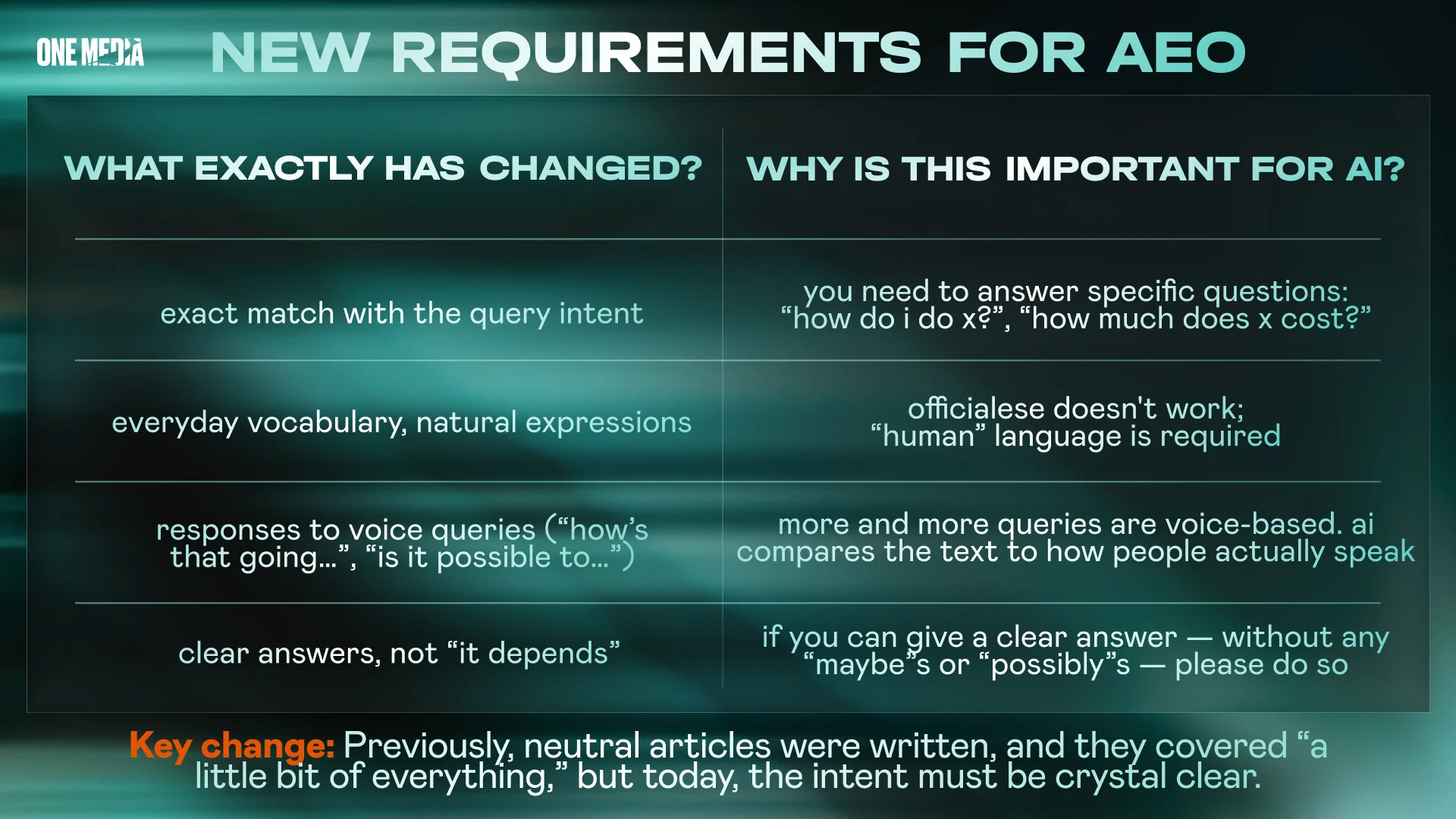
AEO (Answer Engine Optimization) — so that AI responds using your own words. Your website is a source of clear, concise answers. AI takes not only your text but also your writing style.
AIO (Artificial Intelligence Optimization) — configuring access for AI bots. Without it, GEO and AEO simply won't work, because the bot won't be able to access the website.
To summarize: AIO lets the bot onto the website, GEO shows it the right place, and AEO teaches the bot to present information in your style.
Which is more important: AIO, GEO, or AEO? Are they interdependent?
They only work together, but there are indeed priorities here. These aren't three separate strategies, but three aspects of a single one.
1. The most important is AIO
If the bot can't access the site, doesn't understand the structure, or runs into a closed door, it simply leaves — and then GEO or AEO are useless.
2. Second in importance — GEO
Even if the bot has entered (AIO worked), it must quickly find the answer. If it's buried deep in the text, the AI will turn to another source. GEO is what determines whether they'll choose you.
3. Third is AEO (which is also the longest-lasting)
AEO is about style and trust; it doesn't provide an instant result, but turns a one-time mention into a consistent brand reference in all AI responses. This aspect is a long-term game.
How do neural networks "read" AIO, GEO, and AEO?
To clarify: neural networks (ChatGPT, Claude, Gemini) don't "crawl" websites on their own. Special crawler bots (GPTBot, ClaudeBot, Google-Extended) do this for them. Here's how they read AIO, GEO, and AEO:
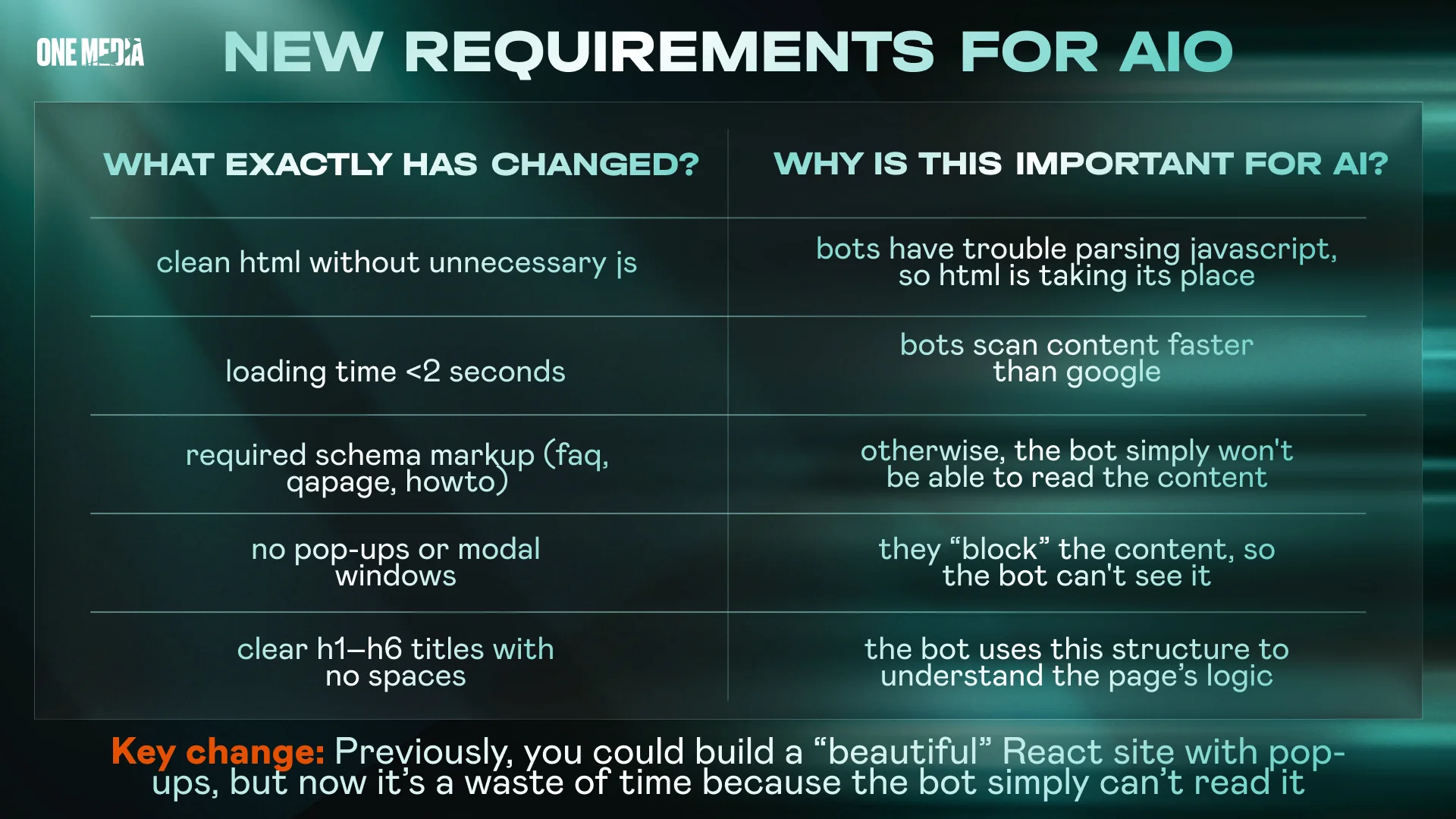
AIO (technical layer): the bot sees robots.txt files, HTTP headers, HTML code, etc. Here, tags and schema markup are a must when filling the site with content
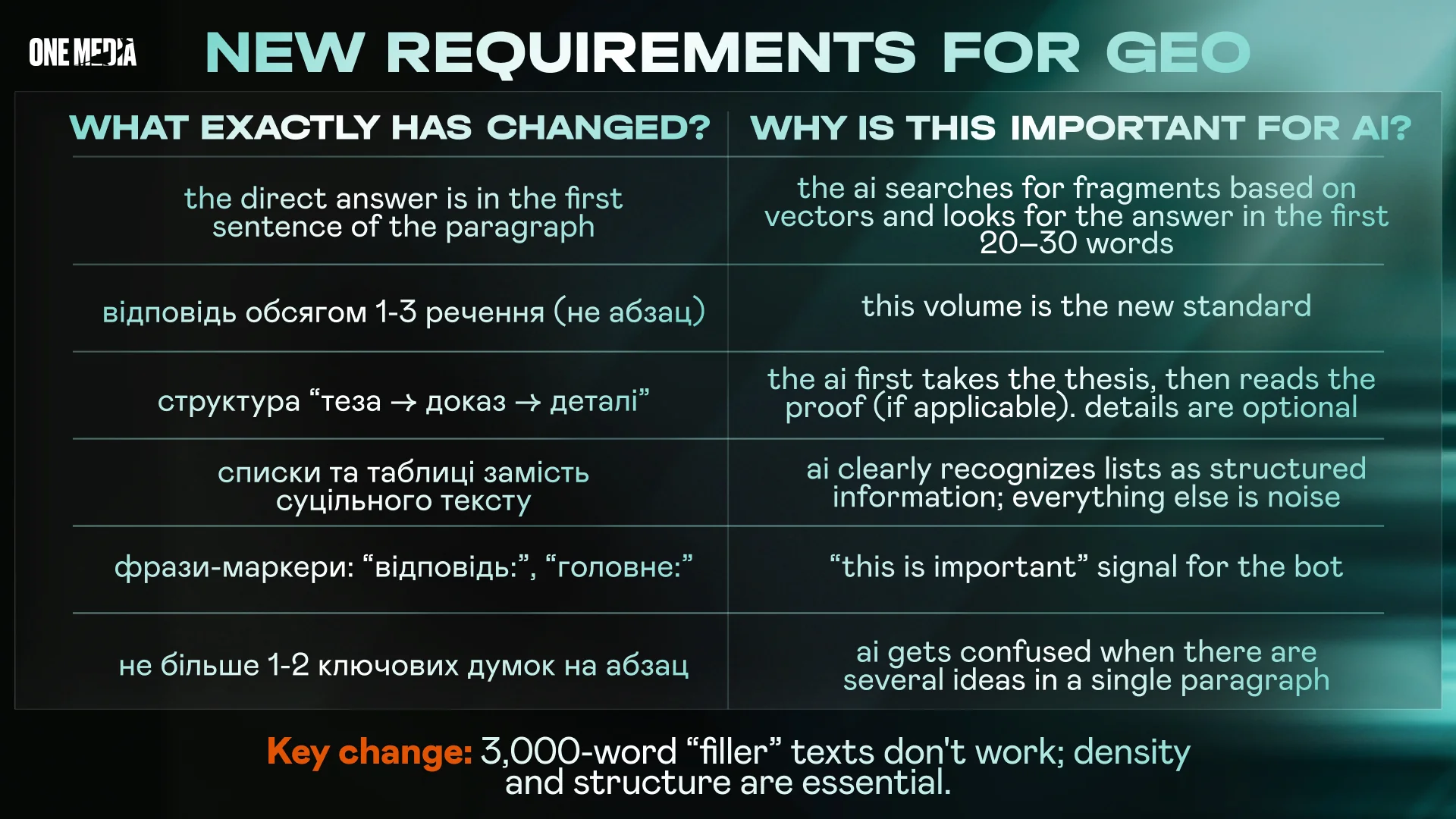
GEO (structural layer): searches for the response with the closest vector to the query
AEO (stylistic layer): the neural network remembers the brand if you've established it and learns from it
Phrases like "This is how we do things at One Media…" or "Our experience shows…" can be memorized and reproduced by AI with proper attribution. That is the goal of a media buyer. The way bots process information is very different from how it used to be.
Do you have any advice for media buyers and technical specialists?
For buyers, the most important thing is to develop these three skills:
Learn to read logs. You need to understand the difference between 200, 404, and 500 status codes. If you spot a problem in the logs, contact a technical specialist immediately.
Understand the difference between a crawler and a neural network. Data isn't updated daily: if you changed the content today, the AI won't respond differently tomorrow.
Analyze test results correctly. You can have a citation share of 10%, and that would be top-tier for iGaming. Or 30% — and that would be poor for a niche B2B topic with little competition.
For technical specialists:
Stop blocking every single bot in robots.txt. Example: Disallow: / for GPTBot; grant permissions for GPTBot, Google-Extended, and ClaudeBot.
Learn to read server logs to detect AI bots. Don't just check for a 200 OK response; pay attention to response speed. Set up a separate log file for AI bots and check it weekly.
Use the data-nosnippet attribute for junk content. Mark sections like the footer, copyright notice, and contact form so bots don't try to include them in the snippet — this will improve the accuracy of search results.
The most successful buyers are those who understand the basics and can quickly review a technical specialist's work and take back control. But when it comes to SEO, it can be difficult to offload tasks from the buyer and the technical specialist. The same cannot be said for driving traffic to apps. To be honest, they're more relevant now than ever, because landing pages have started to deliver poorer results.
This is exactly what One Apps focuses on, providing instructions to technical specialists, while affiliate marketers concentrate on traffic, even without a deep understanding of internal processes.
When learning the technical side of things, buyers shouldn't try to cover everything at once; instead, they should start small. That's why One Apps handles all the technical details — cloaking, integrations, and setup. And this saves lots of time, effort, and money.
What should media buyers focus on right now?
1. Choosing content formats
Format: text + lists + tables + FAQ sections + schema markup. Test different ways of presenting the same information: today, AI prefers lists (product benefits); tomorrow, it might prefer tables (comparisons). Be ready to change page templates.
2. Interacting with various AI bots
There used to be only Googlebot, but now there's GPTBot, Google-Extended, ClaudeBot, and PerplexityBot. New ones appear every month, so monitor for new User-Agents. Don't block them "just in case": first find out what kind of bot it is, then take action.
3. When planning budgets
You need a budget that can be redirected from content to technical aspects and back. I recommend setting aside a small separate budget for experiments with AIO/GEO/AEO and acting according to the results.
How do AIO, GEO, and AEO impact profit?
Those who invest in AIO/GEO/AEO now will see their profit increase by 30–50% in 6–12 months.
The main change: you don't pay for "cold" traffic, but instead invest in having AI generate "warm" leads for free. Looking at the impact of each strategy individually:
AIO: direct impact on the conversion rate — proper optimization increases it by at least 20%
GEO: significantly higher organic traffic flow — ~50% or more, with a ~18% increase in the citation rate
AEO: minimal fraud, and traffic coming from AI search results converts up to 4x (!) better than classic organic traffic
What will working with AIO, GEO, and AEO look like in the future? What should you prepare for?
What you do today will yield results in 3–6 months. This means lower dependence on paid traffic, 40–80% more efficient scaling, and an almost complete absence of bots and non-targeted leads.
The only thing is — buyers need to understand that there won't be any quick results.
AI is a new communication channel, just like Google, social media, and so on, so the learning process is similar. Change is an opportunity, not an obstacle.